
The Ragweed's case
Ragweed is one of the major allergenic plants in Europe, and one of the most important cause of seasonal allergies and asthma.
In order to get to know better this species, we provide an article written by professor Victoria Rodinkova (University of Vinnytsia, UA - President of International Ragweed Society), which explains in detail the problems caused by the widespread of Ragweed.
|
Origin and Distribution The American continent is ragweed's native habitat. It entered Europe starting in the nineteenth century and especially during World War I, probably by accident through imported seeds and contaminated horse feed, and has spread rapidly since the 1950s. In Europe, common ragweed (Ambrosia artemisiifolia) is primarily widespread, which happens to be the most allergenic among all ragweed species. There are about 30 species in total. Currently, the species is widespread in southern parts of Eastern and Central Europe, with invasion hotspots in the Pannonian plains of Hungary, Croatia, Slovakia, Romania and Austria. Ragweed is found in Serbia, Italy, Ukraine and Russia. After the 1980s, Ambrosia spread increased rapidly and became a serious threat to human health in the infested countries. Hungary, Northern Italy, and the Rhône Valley in France are considered the most infested European regions, and intense research activities have been dedicated to this topic. The main factors favoring Ambrosia spread are considered to be inappropriate changes in agricultural practices, urbanization, and the international trade of seeds and grains. Current List of Ragweed-Infested Countries:
|
 |
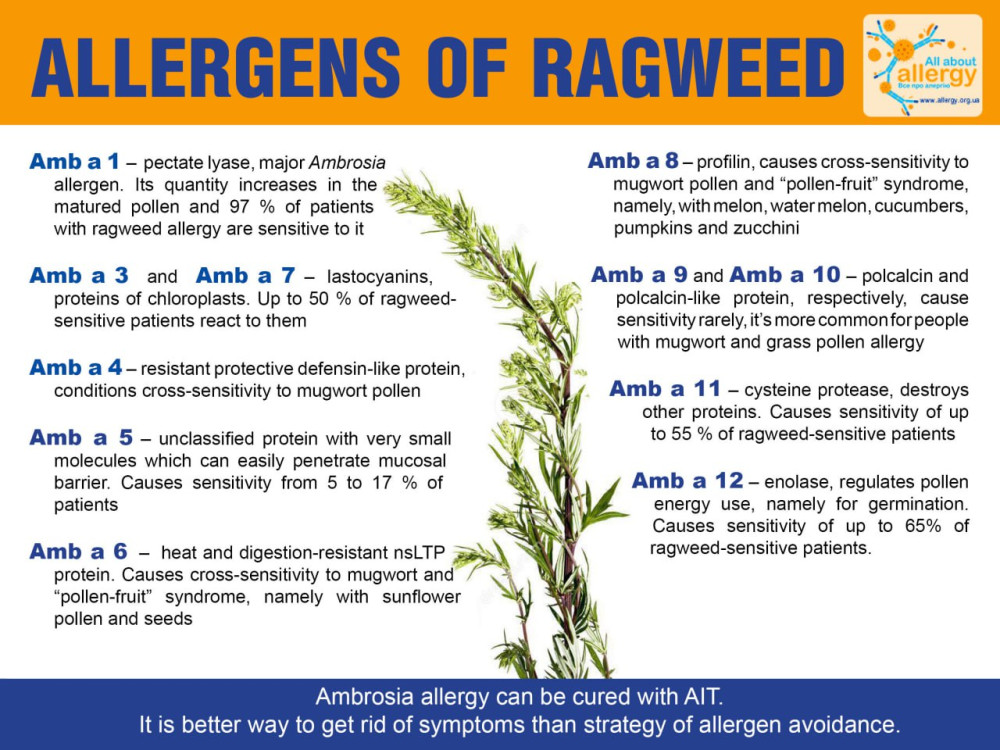 |
Why Is Ragweed So Allergenic? Let's start with the nature of flowering allergy—pollinosis. This disease is caused by proteins contained in plant pollen. Our immune system recognizes them as hostile and produces antibodies that ultimately trigger the allergic response mechanism. Ragweed proteins enter the bodies of sensitive people through mucous membranes, primarily the nose, along with inhaled air. While pollen from other plants may quickly pass down into the respiratory tract, ragweed pollen grains catch on the mucous membrane and have time to swell on it, releasing their contents onto the mucosa. This is because the surface of ragweed pollen has spines that facilitate the penetration of allergens into our body. Another reason ragweed causes allergies lies in the properties of its proteins. Specifically, the first and most important allergen of this plant, Amb a 1, is a pectate lyase. Proteins of this type are responsible for pollen tube growth, through which sperm contained in pollen move to the egg cell of the flower's pistil. When it lands on the stigma of the pistil—the female organ of the flower—pectate lyase causes the softening of plant cell walls, which ultimately allow sperm to pass further from the pistil surface deep into the egg cell. Scientists believe that pectate lyase acts similarly in our body. After pollen swells on the mucosa, the Amb a 1 allergen released from it weakens the connection between our cells, allowing all the allergenic contents of the pollen to enter the bloodstream. There, immune system cells encounter it and synthesize IgE antibodies, which are later recognized by the same immune system as hostile. Moreover, the amount of Amb a 1 in pollen increases as it matures. This is why ragweed pollen is more allergenic at the end of the season, when its main allergen has accumulated in large quantities and actively provokes IgE antibody synthesis. |
Pollen-Food Syndrome
Sensitivity to profilins specifically causes allergic reactions in some people with ragweed pollen allergies after consuming fruits of the gourd family: melons, cucumbers, watermelons, zucchini, and pumpkins. These fruits ripen during ragweed flowering, and there's a belief that ragweed pollen may settle on them.
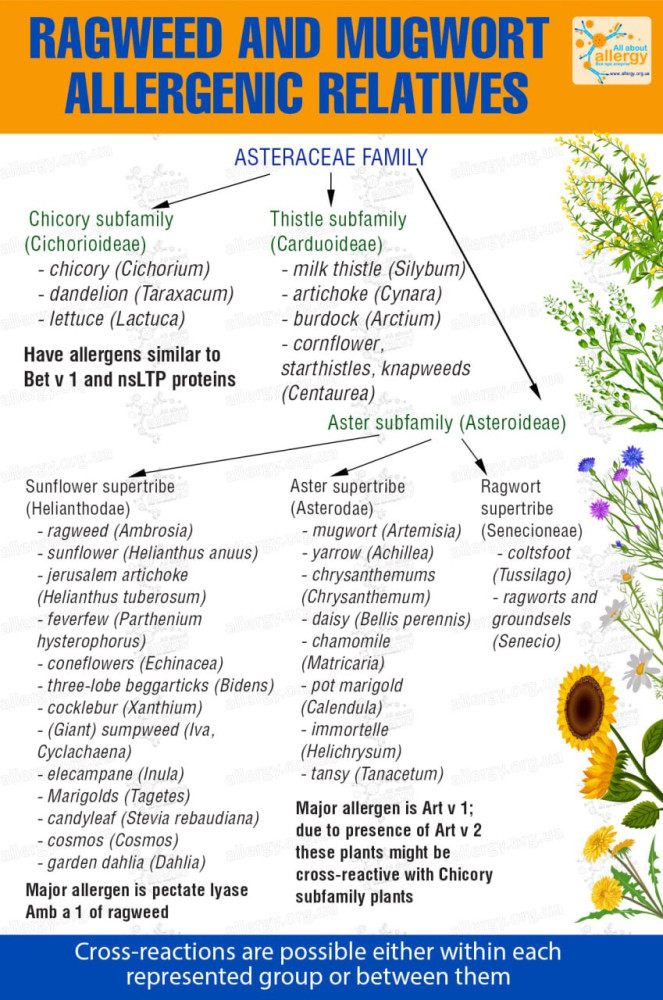
Cross-sensitivity to plant fruits, the so-called pollen-food syndrome, is also caused by LTPs. Additionally, they are resistant to digestion and heating. LTPs, particularly from ragweed, also cause cross-reactivity with similar proteins in sunflowers—both pollen and seeds.
Therefore, people with ragweed allergies shouldn't take selfies with sunflowers. Although these two plants don't look similar, they are close relatives, both belonging to the Asteraceae family.
Almost 55% of people with ragweed pollen allergies are sensitive to another ragweed allergen—cysteine protease Amb a 11. Proteins of this class destroy other protein compounds and may therefore encounter aggressive reactions from our immune system.
Amb a 12 is an enolase that regulates the pollen's ability to use energy, particularly for germination. Two-thirds of people with ragweed allergies are sensitive to this protein.
The last ragweed allergen, Amb a 5, doesn't yet have a name. Its molecules are very small and therefore easily penetrate the blood through mucous membranes. Between 5 and 17% of people who are allergic to ragweed react to it.
Treating Ragweed Allergy
Depending on the type of established sensitivity, an allergist will select the appropriate treatment strategy.
Yes, ragweed allergy can be cured! This is a more effective method of eliminating symptoms than the strategy of avoiding contact with the allergen.
The treatment consists of a course of allergen immunotherapy (AIT), formerly called allergen-specific immunotherapy. During this treatment, small doses of the causative allergen (or several) are introduced into the patient's body so that the person develops tolerance to them over several years. With the appearance of tolerance, allergy symptoms disappear.
However, it's important to correctly select preparations for AIT. Their quality and accuracy of selection are crucial for the success of such therapy.
Preventing Ragweed Allergy
Prevention involves both strategies of avoiding contact with ragweed pollen and timely treatment of the allergy itself.
Why can't contact with ragweed be avoided? It's very difficult because its pollen is everywhere in the atmosphere during flowering. Only about 10 pollen grains per cubic meter of air are needed for symptoms to occur. It's practically impossible to go outside without a mask (which only partially filters pollen) or open a window at night during this period because contact with the allergen will be inevitable.
 |
How to Get Rid of Ragweed? Currently, this is very difficult. The weed easily spreads by seed, and one plant produces up to a billion pollen grains per season. Inept tactics for its destruction, such as improper mowing, have only helped ragweed regrow and form seeds by the end of the season. For example, chaotic random mowing of common ragweed leads to the plant forming lateral shoots in the lower part of the main shoot, which almost lie on the ground. Subsequent mowing won't affect them, seeds will form on these branches that will contaminate the soil, and pollen will ripen closer to the end of the season containing an increased dose of allergen. Therefore, it's considered that ragweed can only be mowed to the root immediately before flowering, when panicle-like inflorescences form but haven't yet opened, which will solve several problems—the formation of allergenic pollen and seeds. The plant can also be either pulled out by the roots (mechanical method) or destroyed with special chemicals. There are also attempts to combat ragweed with robots that can distinguish it well from sunflowers in fields where both plants grow. After recognition, the robot burns only the ragweed, leaving the sunflower undamaged. Therefore, the most effective means of combating the weed is applying a comprehensive approach to solving the problem—using agrotechnical, mechanical, and chemical control methods. The mechanical method should preferably be used in populated areas and on lands with high and very high sanitary-hygienic requirements (lands around residential buildings, public buildings, livestock farms, parks, stadiums, sports grounds, industrial territories, etc.), where herbicide application is not possible. Here, ragweed is destroyed by burning, manual removal, or mowing. On private plots and flower beds, it's most effective to weed out common ragweed plants. The smaller the plant, the easier it is to perform this procedure. Small plants, especially after rain, are well pulled out with roots. However, there are two important details: Fighting ragweed should never be conducted during flowering. The best time to destroy the weed is June: the stem has already grown, but flowers with pollen haven't yet formed. If you pull the plant from the ground or otherwise disturb the stem in July and later, this will only promote the dispersal of pollen and seeds. |
Climate Change and Ragweed
There's one more piece of news, though it's hard to say whether it's optimistic. Ragweed doesn't like drought—not just heat after rain, but specifically dry periods, particularly in June when ragweed is growing. This greatly inhibits its subsequent flowering, much more than heat in August or temperature drops in September. However, carbon dioxide, which is increasingly released into the atmosphere due to climate change, conversely promotes pollen release.
Finnish meteorologists who developed a climate change modeling system claim that ragweed is increasingly moving north. It has already moved to Germany and the Baltic countries, where it still has sufficient moisture. But this means that if nothing is done about climate change, many current ragweed habitats will turn into dried desert, and an ever-increasing number of people will suffer from ragweed allergies due to global warming.